

5G-MOBIX
for cooperative & connected automated MOBIlity on X-border

Project details
- Type
- European project
- Categories
- , Infrastructure, Europe, Research
- Status
- Completed
- Programme
- Horizon 2020
- Dates
- From 1 November 2018 to 30 September 2022
- Location
- Cross-border corridor between Vigo and Porto (Spain and Portugal), plus corridors and test sites in other European countries, in China and in South Korea
- 67 organisations from 13 countries.
How we counted it
67 entities on , counting coordinator, participants, international entities and third parties, from 13 countries. Coordinated by the European Road Transport Telematics Implementation Coordination Organisation (ERTICO), of Belgium. The entities include ALSA Grupo, Vigo City Council, the Spanish Traffic Headquarters (Jefatura Central de Tráfico), Nokia, Ericsson, Siemens, Valeo, Ford Otomotiv Sanayi and Telefónica. Source: 5G-MOBIX on CORDIS - AEVAC's role
- Consortium partner, with documented contributions to business models, cost-benefit analysis, regulatory recommendations and dissemination. Deliverables D6.2, D6.6, D6.8 and D7.7 show AEVAC's specific contributions, detailed below. According to AEVAC, its role was that of a neutral party, with no commercial interests. Source for participation: CORDIS
Recommendations for deploying the autonomous vehicle in Europe
One of the project's final results is report D6.8, of June 2022: European Union policy and regulatory recommendations for deploying connected and . Its central conclusion is that the technology is ready, but that bringing it to the street, and above all across borders, requires policy and regulatory decisions. It gathers 17 recommendations for policymakers and 19 for regulators. They were drawn up with questionnaires to road , operators, industry and universities, and validated with interviews with those who led the tests on the real corridors.
The obstacles it identifies are eight: roaming (the car not losing its connection when changing country) and data governance, infrastructure sharing, the allocation of spectrum (radio frequencies) and , maps and data formats, cost reduction, a guaranteed minimum service, and the reliability of the supply chain.
AEVAC takes part in this report, which belongs to the consortium. Section 4.2.2, signed by David Fidalgo for AEVAC, raises the question of the connection between countries. If an operator reserves part of the network only for automated driving (what is called network slicing), does it comply with the European open internet rules? The report's analysis concludes that it does, because that service does not give access to the internet. But each country assesses it on its own, and the result may differ on each side of the border. That is the point the diagram summarises.
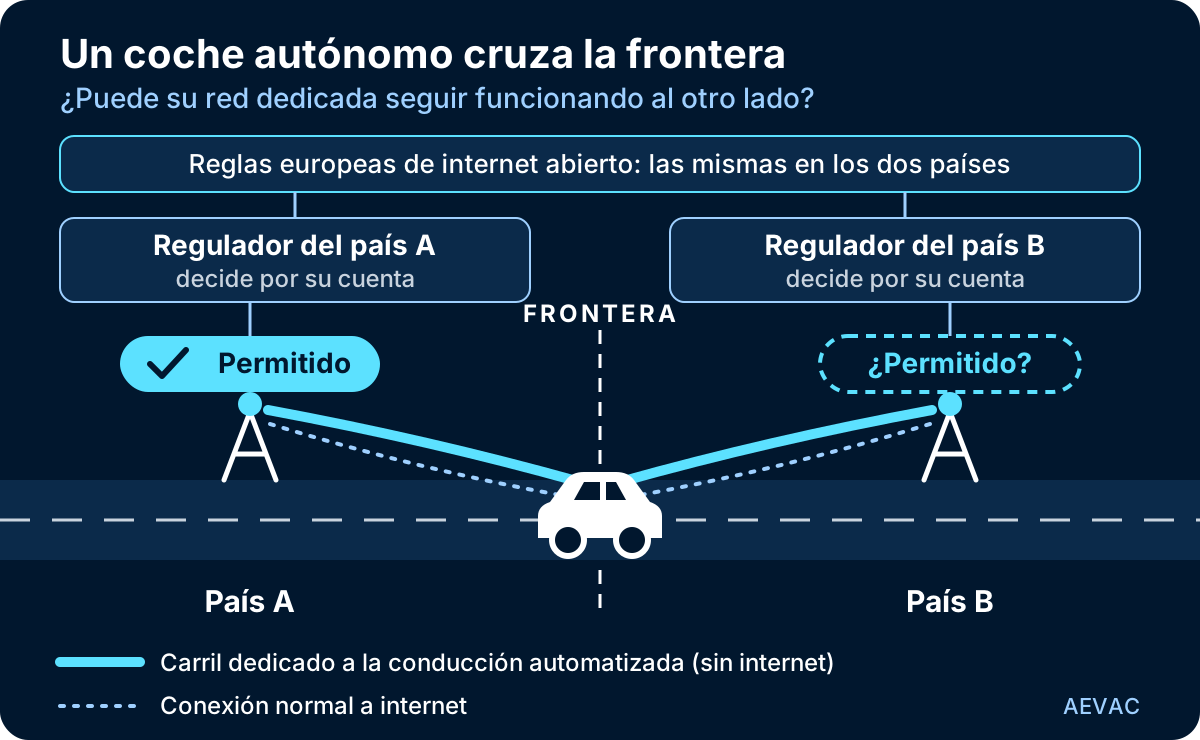
Text description of the diagram
- At the top, a band stating that the European open internet rules are the same in both countries.
- Below, two boxes: the regulator of country A and the regulator of country B. Each decides on its own.
- In the centre, a road crosses the border, marked with a dashed line. An autonomous car is on it.
- The car connects to each country's antenna in two ways: a lane dedicated to automated driving, with no internet access, and the normal internet connection.
- In country A, the dedicated lane is shown as allowed. In country B, it is shown with a question: allowed?
5G deployment study for connected driving
Within 5G-MOBIX, and at the request of the European Commission, a deployment study was carried out: how much additional investment in 5G networks is needed for connected and automated cars to work without interruption on roads that cross borders. AEVAC commissioned and supervised the study within the project, and it was carried out by the consultancy Detecon International.
The study measures the gap between the investment operators already have planned and the investment that would be needed. It answers six questions: what traffic is expected in 2023 and 2025, what connected driving services need in border areas, what investments are already planned, what the gap is between what is planned and what is needed, what is needed to prepare the market and what can be expected by 2030. It studied stretches of about 40 kilometres, 20 on each side of the border, on five corridors: Spain-Portugal (Tui and Valença), Greece-Turkey, Germany-Netherlands, Finland-Norway and Spain-France. It is based on interviews with the parties involved and on network planning simulations of those stretches.
The full report is not public. D6.5 itself explains that no further details can be given for confidentiality reasons, so we do not reproduce its results here. D6.5, of May 2023, includes a summary in its annex 1 and lists AEVAC among its authors. Source: D6.5: final report on 5G deployment options (PDF).
AEVAC's documented contributions
- Business models. D6.2 credits David Fidalgo for AEVAC as author or co-author of sections 3.3 to 3.6, 4, 5 and 6 and of annex 2. They include business models for high-definition maps and public transport services, and the motivations of the actors in the ecosystem. Source: D6.2: business models plan and preliminary report (PDF).
- Cost-benefit analysis. Aitor Fernández appears as author of section 3.5 of D6.6, pages 43 and 44. It analyses advanced driving on the Spain-Portugal corridor: lane merging, automated overtaking and high-definition maps. Source: D6.6: final report on business models, version 2 (PDF).
- Regulatory recommendations. D6.8 credits David Fidalgo's contribution for AEVAC to section 4.2.2, on cross-border connection, network slicing and European open internet rules. The report gathers 17 recommendations for policymakers and 19 for regulators on the deployment of connected and automated driving in Europe; the attribution to AEVAC does not cover the whole report. David Fidalgo also appears as author of review version 0.9, of 21 June 2022. Source: D6.8: final report on policy and regulation (PDF).
- Deployment study. AEVAC commissioned and supervised the study on 5G investment for cross-border corridors carried out by Detecon International, and D6.5 lists AEVAC among its authors. Source: D6.5, annex 1 (PDF).
- Dissemination and prioritisation. D7.7 records AEVAC's participation in ITU Telecom World 2019, the 2020 Smart Cities Congress and Global Mobility Call 2022. It also documents David Fidalgo's contribution on the prioritisation of recommendations at the workshop of 14 July 2021. Source: D7.7: report on dissemination activities (PDF).
These are AEVAC's contributions within joint work. The demonstrations and technical results of the pilots belong to the project consortium.
Description
5G-MOBIX tested connected and automated cars on 5G networks, on cross-border corridors and in urban areas, with real traffic and coverage. It wanted to find out what 5G adds and what is missing to deploy it: standards, spectrum (radio frequencies) and business models. One of the questions was how to prevent the connection from dropping on cross-border corridors. On the corridor between Spain and Portugal, which links Vigo and Porto, vehicle manufacturers, telecoms operators, administrations and research centres worked together. The use cases studied include cooperative overtaking, truck , automated parking and remote driving. It ended on 30 September 2022.
Goal
To assess on real corridors the benefits and costs of connected and automated driving with 5G, and to give recommendations on how to deploy it, which standards are needed and how to allocate spectrum.
Consortium results
- The project carried out the first public demonstration of autonomous driving with 5G on the cross-border corridor between Spain and Portugal, on the Tui-Valença international bridge. Source: 5G-MOBIX demonstration between Spain and Portugal
Technologies
- 5G networks
- Connected and automated driving ()
- Automated last-mile shuttles
- Intercity public transport
Official links
Sources for this page
- 5G-MOBIX on CORDIS
- Spain-Portugal test corridor
- 5G-MOBIX demonstration between Spain and Portugal
- Note: The project's press release mentions 58 entities, other sources 66 entities, and CORDIS now lists 67. CORDIS is used.
- Deliverable D6.2 (PDF)
- Deliverable D6.6 (PDF)
- Deliverable D6.8 (PDF)
- Deliverable D7.7 (PDF)