

Aitor Fernández
He founded AEVAC to promote autonomous mobility in Spain and to build bridges across the sector. He is blind: accessibility is the association's reason for being.
Since 2017 we have brought the users' point of view to autonomous and connected mobility.


AEVAC's president and co-founder, Aitor Fernández, is blind. For him, autonomous mobility means gaining freedom. That is why he founded the association.
is AEVAC's reason for being.
A market study was carried out in 2016. In 2017 the association was officially founded, with the support of the Spanish traffic authority (DGT), the State Reference Centre for Personal Autonomy and Technical Aids (CEAPAT), Telefónica and Mobileye. Aitor Fernández and David Pérez Fidalgo, president and vice president, are its co-founders.
In November 2018 we joined the -MOBIX as partners. A consortium is a group of organisations that carry out a project together. 5G-MOBIX was a European project under the Horizon 2020 programme. The consortium tested connected and over 5G mobile networks, including across borders, as on the corridor between Vigo and Porto.
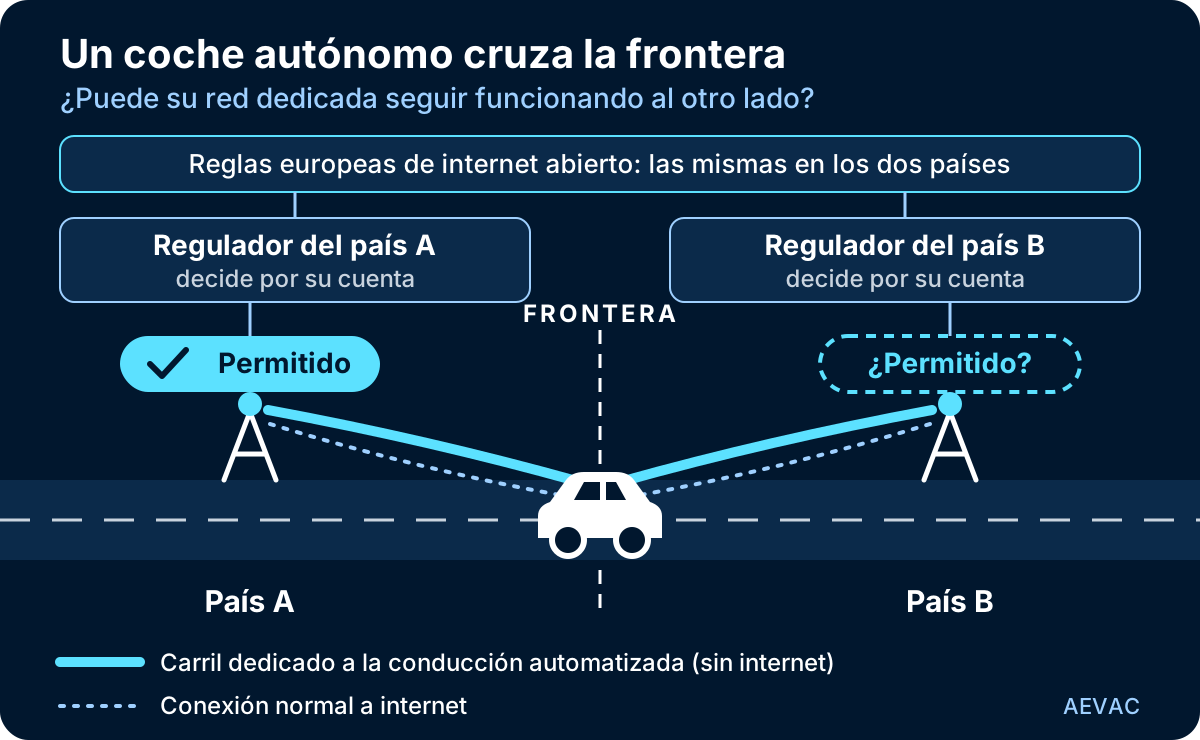
There we were the neutral party, with no commercial interests. We worked on business models and on network analysis. We contributed to the final report on European Union policy and regulatory recommendations that closed the project: 17 recommendations for policymakers and 19 for regulators, so that an can cross borders. We raised a key question: whether the network dedicated to automated driving complies with European open internet rules on both sides of the border. See the project page.
In 2021 we published a roadmap on and legislation for autonomous vehicles in Spain. We analysed more than 2,000 rules and standards from five regions: Spain, the United States, the United Kingdom, Europe and Asia. We selected 350.
To choose the most relevant projects in the world we used two criteria. The first is the level of autonomy, according to the SAE scale (the society of automotive engineers that defines six levels, from 0 to 5). The second is the maturity level of the trials, measured in (technology readiness level, a scale that goes up to 9).
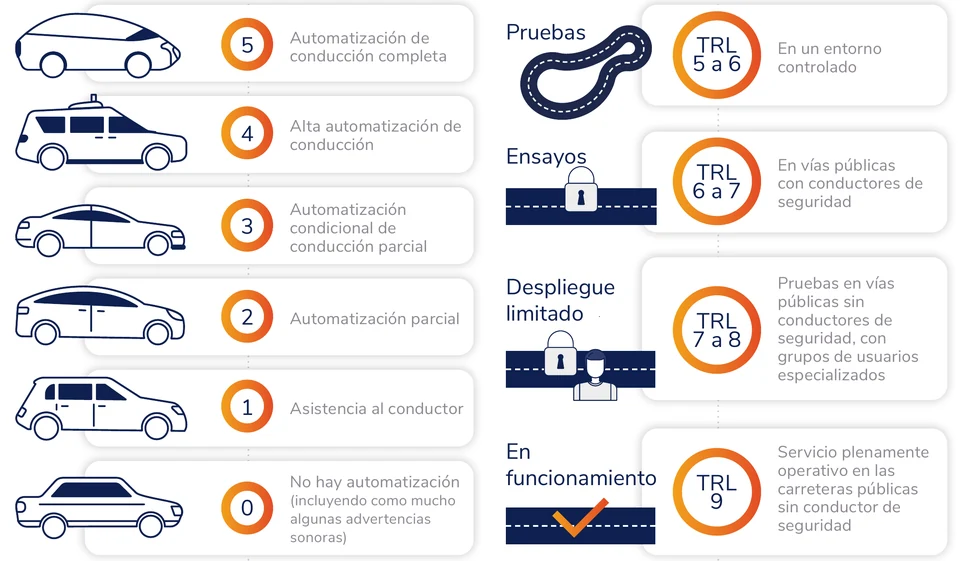
Levels of autonomy:
Levels of deployment, from least to most mature:
We then drew up a standardisation map. We defined six critical technology areas of the connected autonomous vehicle and six groups of and end users of those standards. First, the standardisation within each technology area is described, and then its application to each group.
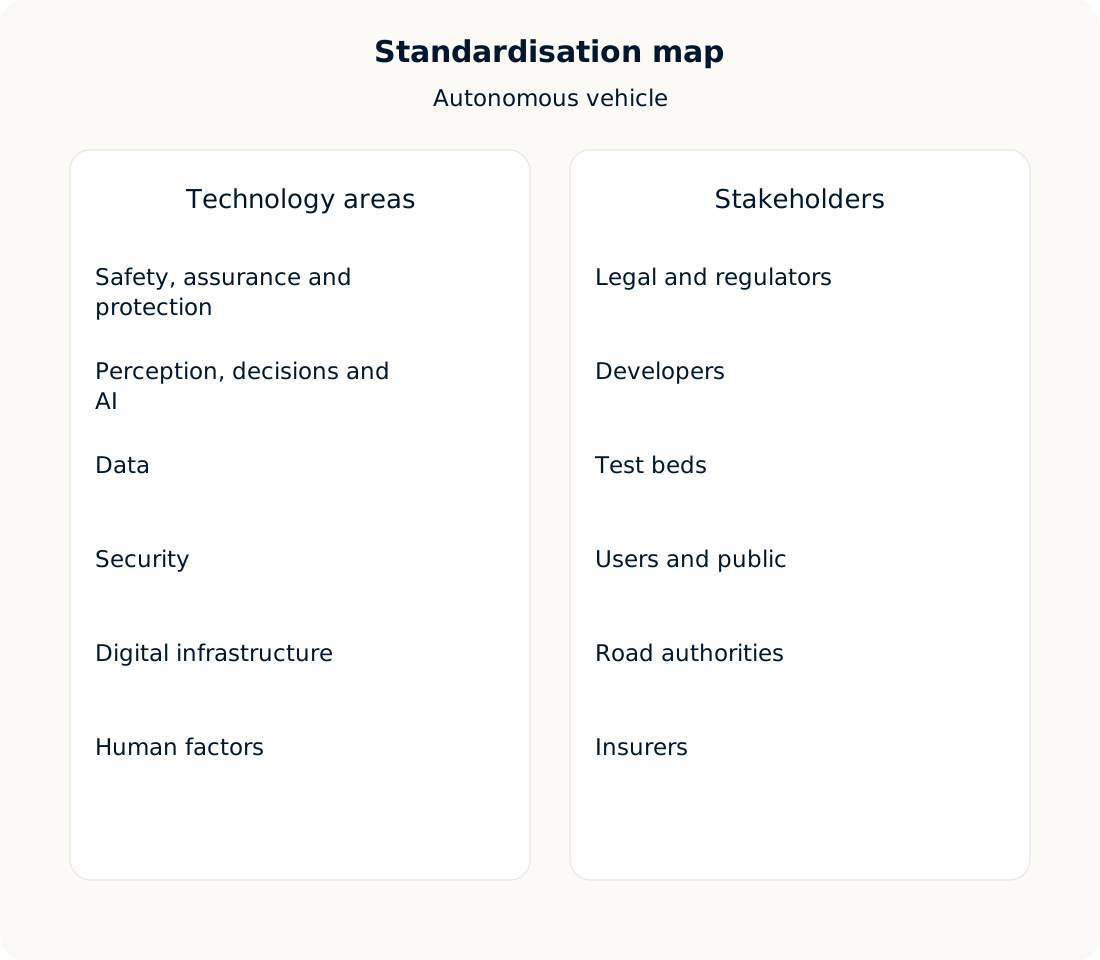
A car sits in the centre. Around it, in the inner ring, are the six technology areas:
In the stakeholder column, are the six groups of actors:
That roadmap opened the door to SELFY, a European project on the of the . In June 2022 we joined the consortium as partners.
In SELFY, the roadmap was the basis for identifying cybersecurity and accessibility standards. We led the standardisation and social sciences task: surveys, critical standards and workshops with the FAME and CONNECT projects. SELFY ended in May 2025.
In two other European projects we were external advisers. In DIAMOND, from 2018 to 2022, we worked on the roadmap of the needs of a person with a disability when using a service in an autonomous vehicle, at every stage. In SHOW, from 2020 to 2024, we contributed the point of view of users and of accessibility.
Source: 5G-MOBIX: 825496, 5G-MOBIX on CORDIS; SELFY: CORDIS 101069748, SELFY on CORDIS; SHOW; DIAMOND
Our mission is for autonomous mobility to be developed and adopted in a way that guarantees the independence of everyone.
We want public administrations and companies to build together an autonomous transport network that anyone can use. We think above all of those for whom mobility is out of reach today, such as many people with disabilities.
And we want autonomy and connectivity to also help improve infrastructure and the environment.
Our team includes people from different technology sectors.
He founded AEVAC to promote autonomous mobility in Spain and to build bridges across the sector. He is blind: accessibility is the association's reason for being.
More than 25 years in automotive and (objects connected to the internet): electrification, connectivity and autonomy. Founding member of the GENIVI Alliance (2013).
Behind AEVAC there is an international network of professionals in Spain, Germany, the United Kingdom and the United States: executives of mobility and autonomous driving companies and technical specialists who have followed every development of the autonomous vehicle since 2017. A core leadership team coordinates, and around ten experts are brought in according to each project.
AEVAC is a non-profit association registered in the National Register of Associations, number 614559. It is run by its board of directors, with the support of an advisory committee.
We collaborate with companies, universities, technology centres, public administrations and institutions. Each relationship is documented, with its source, on the Ecosystem page. We have also taken part in working groups of the World Economic Forum, the OECD and the ITU, and of the DGT in Spain. We took part in ISO committees in the past, without being formal members.